One morning, one of the security guards at JAMPRESS had poked his head into the newsroom and alerted me to visitors in the lobby. This was in November, after I had been on the job for about eight months. I thanked him and folded the newspaper I had been reading. In fact, all of us reporters there at the time had been reading the dailies. If we hadn’t been scheduled for an early assignment to cover, we would reserve some time each morning to scour the papers. We were reading for two reasons – three, actually. Naturally, we scoped the headlines to stay abreast of the news. Secondly, we read to discern if there were happenings that warranted follow-up stories we could write, or even news features. But we also read the papers religiously every day with keen eyes to spot the stories we ourselves had written that were now appearing in print.
It brought a measure of satisfaction to see our work published. Remember, JAMPRESS was a news agency whose products were distributed to all the media houses. Some mornings you would hear a reporter declare excitedly: “I got a byline!” That occurred when one of the newspapers had printed one of our stories, giving full attribution – not a half-hearted: “According to JAMPRESS”, or “So and so told JAMPRESS”, or “Jampress”, written as a word and not an acronym at the end of a story – but full recognition: reporter’s name and organization. So every morning we read The Gleaner, the granddaddy of them all, The Jamaica Observer, and the Jamaica Herald. Later in the afternoon, we would page through the Star, a tabloid published by the Gleaner Company. But let’s not keep the visitors in the lobby waiting much longer.
I went out to the lobby and introduced myself to the two men waiting. They introduced themselves in turn as representing the Natural Resources Conservation Authority (NRCA) and asked if I had a few minutes. I directed them into the newsroom and toward my desk. They gave their names and explained that they were environmental officers with the NRCA. “You mean officers, as in environmental police?” I asked in my mind. At that moment, my colleague, Andrea Watson, flashed me the look. It was the facial expression that communicated: “You’re in trouble.” Then one of the men pulled out a newspaper clipping and unfolded it to reveal a story I had written and which had been published in the Star – but only with “JAMPRESS” at the end of the report (Imagine that!). It was about a man’s encounter in the marsh with a crocodile.
The Star had assigned its own headline to my story: “Man held at bay in swamp by angry crocodile”. But the original JAMPRESS headline, a cleverer one, if you ask me, was assigned by Godfrey Barnes, my editor at the time. It read: “Broom-maker’s Brush With Death”. Get it? It was an incidental story about Leroy Vernon who had to be plucked from the mangroves along the Mandela Highway in Kingston on account of a crocodile. Incidental because photographer Dennis “Richie” Richards and I had originally been assigned to cover the opening of a training course for surveyors from the Survey Department in the use of GPS mapping. The then minister of agriculture, Roger Clarke, now deceased, had said the new mapping system would cover 650,000 parcels of land across the island and was key to an urgently needed cadastral map for proper land management.
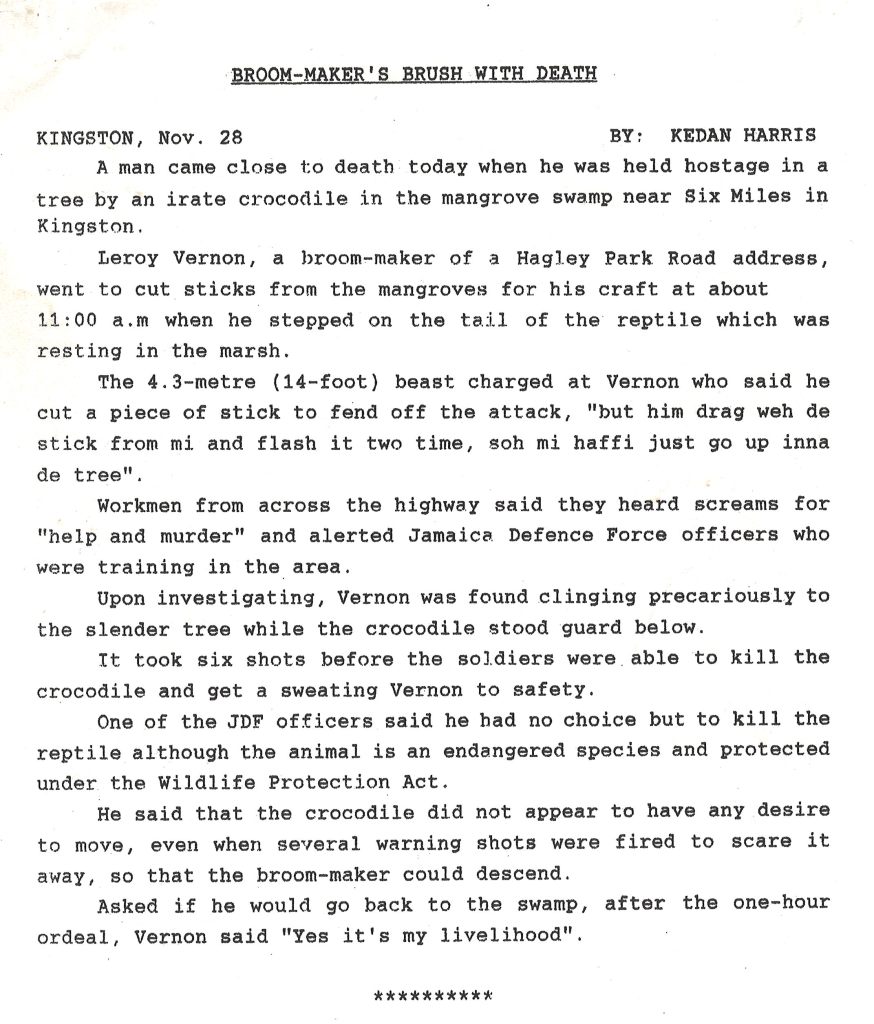
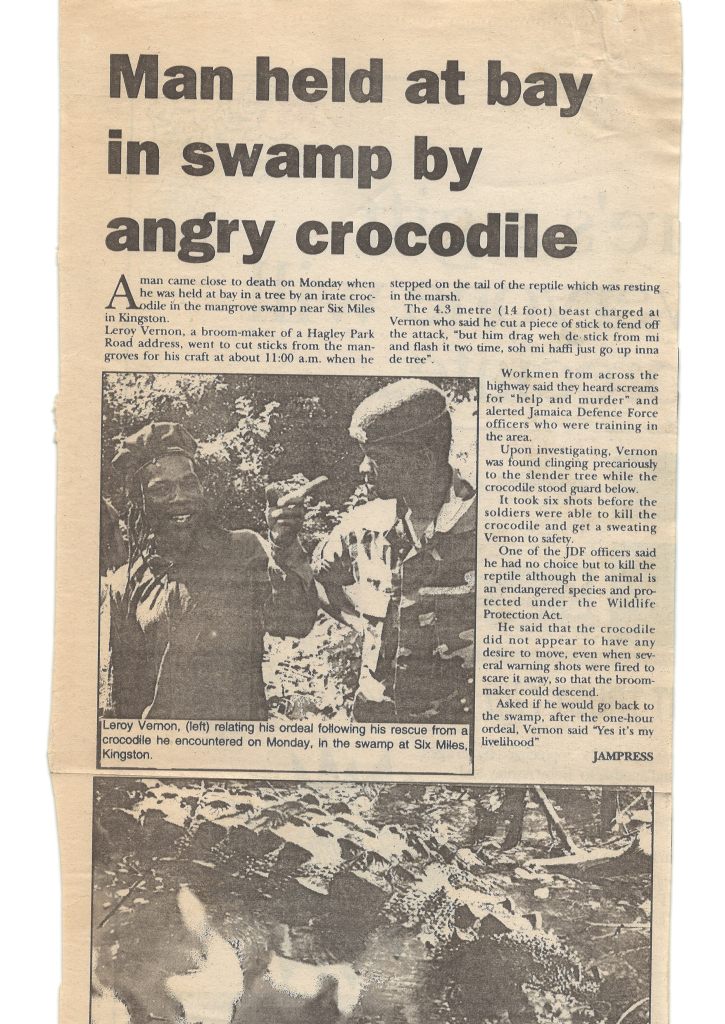
Richie and I had completed our assignment and were traveling back from Twickenham Park, Spanish Town, where the opening of the training course had occurred. As we approached the section of Mandela Highway just before Six Miles, we observed a group of people moving about excitedly at the side of the road. Richie slowed the car and pulled off the highway to ascertain the reason for the commotion. A man reported that someone was stuck in the mangroves because a crocodile had chased him up a tree. Richie and I looked at each other. The GPS training report could wait. We were going to cover this. We hopped out the car, grabbed our equipment and headed for the marsh. As we spoke to people on scene, we came to learn that it had been some workmen across the highway who had heard screams for “Help!” and “Murder!”
The shrieks were coming from Leroy Vernon, a broom-maker who, at the time, lived along Hagley Park Road in Kingston. He had gone into the marsh to chop sticks for his trade and had inadvertently stepped on the tail of the crocodile, which responded aggressively, causing him to chop a piece of stick to defend himself. “But him drag weh de stick from mi and flash it two time, soh mi haffi just go up inna de tree,” Vernon told me when I had interviewed him after the ordeal. His rescue had come courtesy of soldiers from the Jamaica Defense Force (JDF) who had been training in the area and had been alerted to the desperate situation. Before that, Richie had made his way down closer to the scene and had taken some shots. But he wanted to proceed even closer to get a few more, just in case.
By this time though, the boots on the ground had cordoned off the area and set up a perimeter. Consequently, the soldiers would not allow Richie to get any further and a true photojournalist, Richie negotiated with one of them. The essence of it was: “If you won’t allow me further, then take this camera and get me some shots.” The soldier agreed and disappeared into the bush – and there were shots indeed. But these weren’t clicks from Richie’s camera. Instead, “Bow!, bow!,” rang out from the mangroves. The soldiers had fired warning shots to try to scare the 14-foot crocodile, but to no avail. It had parked itself at the foot of the slender tree and was playing the waiting game. Slender, because mangroves are not like sturdy mango trees, good for climbing. So you can appreciate how Vernon must have been clinging desperately to the willowy branches for protection.
“It took six shots before the soldiers were able to kill the crocodile and get a sweating Vernon to safety,” I had written in my report. I have kept every story I had written during my time at JAMPRESS, along with newspaper clippings from when they had been published in the dailies, but in the case of this story, as was mentioned, it had appeared in the Star. I had asked Vernon if he would go back into the swamp after his one-hour ordeal with the crocodile, to which he responded, “Yes,” explaining that broom-making was his livelihood. Hand-made brooms have a long tradition in Jamaica. Growing up, we had our favorite “broomie”, a broom-maker who would walk throughout our neighborhood with an assortment of brooms on his shoulder for sale. Some brooms were made to handle the rigors of sweeping the yard, others were slender for lighter duty. There were even short-handle brooms for small areas, like sweeping dust or debris off car mats.
But the question remains: Why had NRCA officers been at my desk with a copy of the published story? My reporting had mentioned that one of the JDF officers had said that there was no other choice but to kill the crocodile. This, “although the animal was an endangered species, protected under the Wildlife Protection Act,” I had noted in my report. The killing of the crocodile had caught the attention of the NRCA and the two officers had been dispatched to investigate if destroying the animal had been absolutely necessary. I recounted to them the whole episode, including how Vernon seemed to have been losing hope by the minute after an hour clinging to the tree and how the soldiers had fired warning shots, regrouped when those hadn’t changed the situation, then decided to go lethal. The NRCA officers asked if I knew where the animal had been taken after it was loaded onto an army vehicle. Then they thanked me for my cooperation and left. I have no idea what ever happened to Leroy Vernon and if he had made good on his promise to return to the mangroves. But at the time, that whole experience had made me pause. What if I had encountered a 14-foot crocodile?


 Have You Read This One?
Leave a comment